Friday, February 09, 2007

Indian Online Advertising Market

I estimate the following size of the Indian Online Advertising Market during the year 2006 (Jan-Dec basis)

Display Advertising Revenues

  • Rediff 15.0
  • Yahoo 12.0
  • Indiatimes 6.0
  • Web18 Group 3.0
  • MSN 2.5
  • Sify 2.0
  • Naukri 1.3
  • WebDunia 0.8
  • Others 5.0

Total Display 47.5

  • Search Advertising 15

Grand Total 62.5

Key trends that have emerged during the last year:

- Search accounts for almost 24% of the total Ad Market
- 90% of online advertising revenues go to Top 8-10 portals / portal group sites.
- Growth in Online advertising over 2005 is close to 100%.
- Most of the advertising is being sold directly by the Publishers. Ad networks still do not enjoy a noticeable share
- Almost 30-40% of Advertising is happening through Direct deals between Advertisers & Publishers.
- More and more advertisers are using online medium
- Almost 70% of Online Advertising is happening for "performance"
- Largest categories are Internet players & Financial services. These two together would account for close to 60% spends.


Saturday, January 06, 2007

Online Advertising: Advertising Units & Options

Following up on my last post where I had explained the terms used in buying of Online Advertising. In this post I am attempting to explain the Advertising units, sizes & Options.

Advertising Units

A digital image is made of basic units called pixels. Advertising Units on the Internet are called "Banners" and are measures & expressed in the same standard measuring unit - pixels. This is also the same unit that measures resolution / screen size of any Computer Monitor. The most commonly used resolutions in India are 800 x 600 pixels and 1024 x 768 pixels. The first number always indicates the number of horizontal pixels.

728X90

300X250


Indiatimes Home Page - 230 X 250

Sections

Advertising units can be placed in various sections of a Website – like Homepage, specific section pages etc.

ROS(Run of Site): This refers to placing ads across different sections on the site on a random basis. Websites take ROS ads for non premium sections / pages of their websites.

Innovations

Publishers offer use of various high impact & innovative advertising units in addition to the normal ad banners. Few such innovative options are:

Site captures / Interstitials: Ad formats that interrupt sequential content, forcing exposure to the advertisement before visitors can continue on their content path. Interstitials are a form of interruption marketing. This quality appeals to advertisers who feel Web advertising needs to be more like a broadcast medium to be effective.
Few Indian sites that allow Site captures are Indiatimes, MoneyControl, Exchange4Media etc.

Pop ups / Pop unders

Expandable Banners: See the following image for example of expandable banner. In this the banner loads as 4 times its contracted size (180 X 150 pixels) and then settles down back to 180X150 after playing the advertisement.


Shoshkeles / Floaters: Browser driven, platform agnostic, sound enabled, free moving forms. These do not require plug-ins, and there is no discernable download for users.

Click here for an example of Shoshkele on Indiatimes.com

In the absence of any standards each publisher is deciding their own sizes. As a consequence, there are just too many sizes of advertisements floating around. There is a need to have few standard sizes to make life simpler for Advertisers & Agencies.

Thursday, November 30, 2006

Online Advertising terminology: Explained

In this post I am explaining various terms used in Online Advertising:

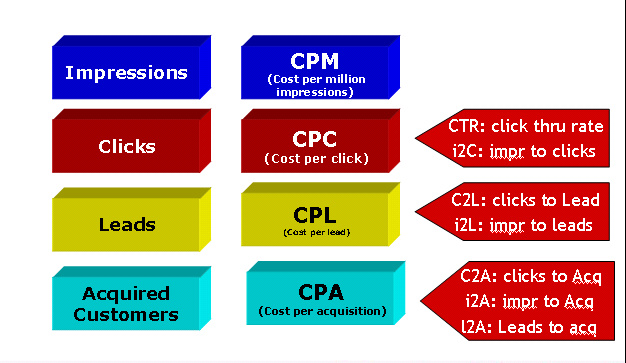
CPM (Cost per thousand)

The basic currency / unit of purchase of Internet ad inventory is “Thousand” impression blocks. Cost per thousand is referred as CPM. (M here stands for ‘Milli’ in Latin which means ‘Thousand’)

CPC (Cost per click)

Whenever a surfer clicks on a Banner Ad, it is recorded as a “Click”. The percentage of number of clicks from number of impressions is measured by Click Though Ratio (CTR). So for Eg if 1,000 impressions lead to 5 clicks then the CTR will be 0.5%.

CPL (Cost per Lead)

A lead is defined as a potential customer who is interested in buying the product advertised and provides his contact information like email id , contact numbers etc. Today a bulk of Online Advertising is happening for generation of leads.

I2L : Impressions to Leads ratio. Number of leads from served Impressions. If we get 1 lead from 1,000 impressions then i2l will be 0.1%.
C2L: Clicks to Leads ratio: Number of leads from clicks. If 5 clicks yield a Lead then the C2L will be 20%.

CPA (Cost per acquisition)

Generally a whole lot of Product Categories need Offline Sales teams to “close the sales loop”. Typically, in such cases the leads generated Online are passed on to the Sales organisation who close the loop by talking to / meeting the prospective customer.

However, for online organizations like a Travel Portal, acquisition will happen when the customer finishes an online transaction like say buying a ticket. Technology easily allows us to monitor the number of people coming to a site from an Online Ad campaign to ascertain how many people who clicked and reached the website actually ended up completing a transaction.

C2A : Clicks to Acquisition ratio. Number of Acquisitions from people who clicked on a particular Banner Ad. If we get 1 transacting customer lead from 100 clicks then the C2A will be 1%.


Metrics stem from objectives

The following illustrations will give a clearer picture of the terminology used and the way Online Advertising campaign objectives and Metrics are juxtaposed & viewed .


Friday, November 10, 2006

Online Travel India: Size of business

Following my earlier posts on online travel:

Crowded skies or crowded online travel space?
Action in Indian online Travel space

I have tried to calculate the size of India business of all the travel portals.

I estimate that close to 1,00,000 Air tickets are being sold every day in India. Out of this nearly 20,000 are being sold online. Online tickets are sold by Online Travel Portals / Agents & Directly by the Airlines Websites. Out of this 20,000 I believe that Online Travel portals are selling around 4-5000 tickets per day.

At an average ticket value of Rs. 3,000 the total revenue (Gross revenue) earned by Online Travel Portals from sale of Airline Tickets would be in the range of Rs 430-540 Crores. The portals would be getting a net commission ranging from 0.5% to 7.5% from various Airlines. At an average commission rate of 3-4%, the net revenue would be between Rs. 13-22 crores.

www.MakemyTrip.com has emerged as the clear leader enjoying more than 50-55% of the market share. Indiatimes travel and Yatra follow behind with close to 10-15% market share each. Other prominent players include Travelguru, Cleartrip , Xplorz etc.

The Air Tickets business would be forming almost 90% of the total revenues of the online travel portals. 10% revenues would be coming from Hotel bookings, Taxi rentals Packages etc. The margins on these products would be much higher going up to almost 20%. This would give them another Rs 10 crore in net revenues. This makes the total business size around 25-30 crores in net revenues.

What will be very interesting to see is how the market shares will pan out once the global biggies like Expedia & Travelocity come in (Both of them are going to soon launch their India business) as well as the larger brick & mortar players like SOTC/ Kuoni & Thomas Cook throw their hats into the ring.

However, one thing is very clear - the volumes of business being done by Online Travel Portals will continue growing exponentially over the next 2-3 years.